

AI car rental support is useful when it shortens the distance between a traveler's question and a correct action. It is not useful when it confidently repeats generic policy, hides its limits, or traps someone in a loop on pickup day.
At Orcar, we have learned that the right question is not, “Can AI answer everything?” The better question is, “Which requests can AI resolve safely from verified reservation and policy data, and which requests need a person?” That distinction matters when the issue involves identity, payment, a vehicle, or an accident.
The useful standard for AI rental support
A rental assistant should do three things before it tries to act:
- Understand the goal. “Can I cancel?” is different from “How much would I get back if I cancel?”
- Use the right source. General rental guidance should come from a maintained policy base. Booking-specific answers should come from the authorized live reservation.
- State its boundary. If the request needs judgment, partner coordination, or a safety response, the assistant should hand it to a person.
This is consistent with public service guidance. The UK Government Digital Service recommends explaining what a chatbot can and cannot do, building a structured knowledge base, and providing a route to a real person so users do not get stuck in a loop.[1] NIST also notes that human and AI roles should be clearly defined, because some systems can act autonomously while others should defer to a human expert.[2]
What Orcar's data actually shows
In Orcar's internal operations sample covering September 1 through December 1, 2025, Mobi handled 2,541 of 3,719 customer inquiries. The weighted AI handling rate was 68.32%.
That number needs context. Monthly handling fell from 74.34% in September to 60.76% in November as inquiry volume and complexity increased. This is a historical operating baseline, not a current performance promise. It tells us something more useful than a headline automation rate: an AI assistant's value depends on the mix of questions it receives and on whether its product tools keep pace with demand.
That lesson shaped Mobi's move beyond a FAQ bot. Instead of only retrieving articles, the current system can work with authorized reservation context, read live reservation state, apply Orcar-owned policy, prepare a cancellation, and escalate a case with context. The identity verification guide explains the related pre-pickup verification flow, while the contactless pickup guide shows why completing key checks before arrival matters.
What Mobi can do before a human joins
For a traveler, useful automation is practical and specific. Mobi can currently help with tasks such as:
- Answering rental-policy and operational questions from Orcar-managed sources.
- Finding a reservation candidate and authorizing support access using registered-driver information.
- Reading live reservation details after access is authorized.
- Calculating a cancellation outcome, explaining the refund and fee, and waiting for explicit confirmation before the cancellation proceeds.
- Finding nearby practical services, such as a gas station, when the traveler provides a location.
The important design principle is that a consequential action should not happen because the assistant merely inferred intent. A cancellation, for example, should be calculated, explained, and explicitly confirmed. This keeps speed without treating convenience as permission.
When a human should take over
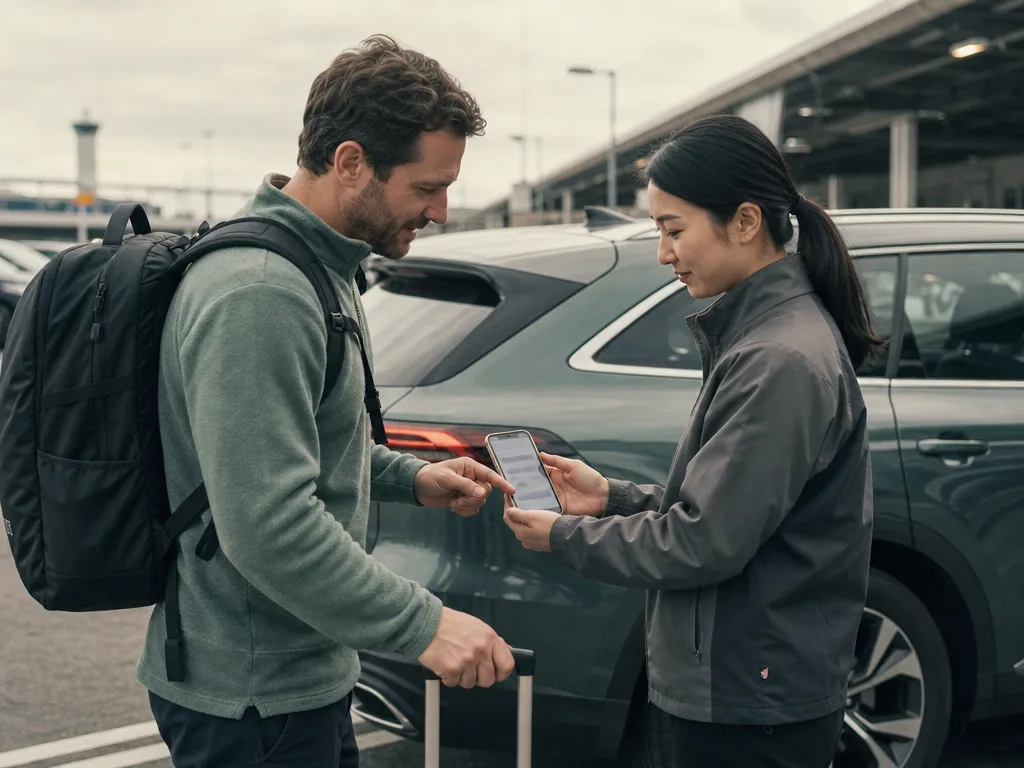
Some requests should leave the automated path quickly. At Orcar, human support is the right destination for accidents and damage, disputes or claims, urgent parking-zone access, manual verification corrections, vehicle or time changes that require partner coordination, and any explicit request to speak with a person.
A good handoff is not “I cannot help.” It should preserve the conversation, identify the traveler's goal, attach the authorized reservation context when available, and stop automation from continuing over the human response.
Human review must also be meaningful. The UK Information Commissioner's Office recommends defined review criteria, trained reviewers, override logs, and a fallback to hybrid or manual processing when automated performance falls below an acceptable level.[3]
How travelers can get a faster resolution
- Start with the outcome you want. Say “I want to know my refundable amount” or “I need to report damage,” not only “Help.”
- Use the official support channel. Do not send passport, license, payment, or booking details to an unverified account.
- For booking-specific help, have the registered driver's name and phone number ready. A reservation number can help locate a booking, but it should not replace authorization.
- Ask for a person when the issue is urgent, safety-related, disputed, or requires a booking change. This is the correct path, not a failure of the service.
- For general Korea travel help outside the rental itself, use an official source. The Korea Tourism Organization's 1330 service provides telephone and real-time chat information for travelers and accepts tourism complaints.[4]
AI support works best as a fast operating layer with clear limits. The goal is not to remove people from rental service. It is to let software handle the repeatable work and bring a prepared human into the moments where context, authority, and judgment matter.
FAQ
Can an AI assistant cancel my Orcar reservation?
Mobi can calculate the cancellation result and explain the refund and any fee. The cancellation should proceed only after the reservation is authorized and you explicitly confirm.
Should I send my passport or driver's license in chat?
Only use Orcar's official verification or support flow when the service specifically requests a document. Do not send sensitive documents to an unverified account.
When should I ask for human support immediately?
Ask for a person for accidents, damage, disputes, urgent access problems, document-correction issues, partner-dependent booking changes, or whenever you are uncomfortable continuing with automation.
Sources and data note
- UK Government Digital Service, Using chatbots and webchat tools
- NIST AI RMF, Human-AI interaction
- UK ICO, Human review
- Korea Tourism Organization, 1330 Travel Helpline
Orcar data note: 3,719 inquiries from September 1 through December 1, 2025; 2,541 marked as AI handled; weighted handling rate 68.32%. The sample is historical and should not be read as a current service guarantee.