
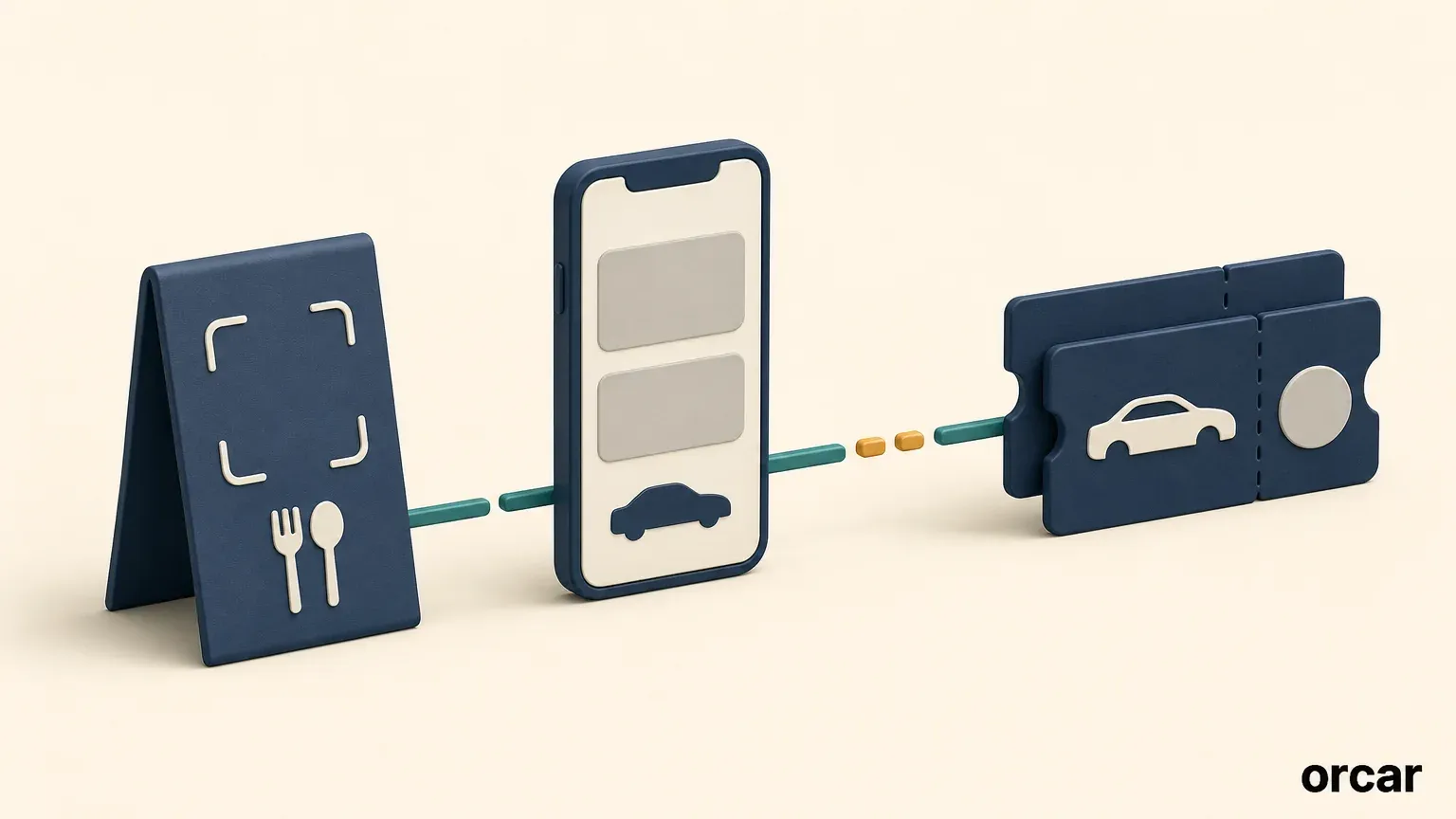
A QR scan is not a booking. For a rental company working with a restaurant, hotel, or visitor business, a useful campaign report must separate the printed placement, the measured visit, the outbound action, and the independently confirmed outcome. The crucial question is not simply how many people scanned, but which part of the journey each business can actually verify.
This is Orcar's proposed measurement checklist for local rental partnerships, not a launched campaign, customer success story, or promise of a current tracking feature. The illustration is conceptual; its blank scan frame is not a usable QR code.
1. Choose the direction before choosing the metric
Consider two hypothetical, opposite journeys. A restaurant counter sign sends diners to a car-rental booking page. A rental pickup counter sends travelers to a restaurant page. They are not the same acquisition campaign, even if the businesses share a logo on the material.
In the first journey, a paid car reservation may be a relevant outcome. In the second, travelers may already have their rental: a menu view, directions click, table reservation, or independently verified redemption is more relevant. Do not measure restaurant promotion by new car bookings merely because the rental company hosts the landing page.
Before printing, agree on the promoted business, placement, destination, intended action, who owns the final record, and what may be shared. An outbound restaurant link click proves a handoff, not a table booking, visit, meal payment, or commission entitlement.
2. Give each placement a stable, non-personal label
Google documents utm_source, utm_medium, and utm_campaign as campaign parameters, with utm_content used to distinguish creative variants. Values are case-sensitive. [6]
For an illustrative restaurant-to-rental campaign, a naming scheme could be:
utm_source=local_partner_demo: the referring business label, not a guest.utm_medium=qr_print: the consistently defined channel.utm_campaign=rental_referral_demo: the campaign identifier.utm_content=counter_card_a: the placement and creative version.
These are example values, not an active offer or Orcar configuration. Keep a small placement register with its destination, displayed language, print version, activation date, and retirement date. A forwarded link still carries its label: it does not prove that the later reader stood at that counter.
A static QR can encode a UTM-tagged URL. An editable redirect is an optional extra layer for changing destinations and observing redirect requests, not a requirement for campaign tags to work. If using one, verify the destination and tags after every redirect and language switch. Do not silently reuse an old placement label for a new offer.
3. Separate the evidence at each handoff
| Stage | What you can report | What it does not prove |
|---|---|---|
| Redirect request, if logged | Requests to the campaign link under stated filtering rules | Unique people or successful page loads |
| Measured landing session | A recorded visit associated with the campaign | Every scan or every visitor |
| Outbound action | A recorded click toward the partner | A confirmed partner booking |
| Confirmed outcome | A deduplicated booking or redemption supplied by its record owner | An incremental sale caused by the QR |
| Reconciled value | The defined amount after applicable cancellations and refunds | Profit or payable commission without agreed cost and contract rules |
Repeat scans, automated requests, consent choices, blockers, browser changes, and cross-device journeys can make these totals differ. A redirect-minus-session gap is not a count of people who abandoned the page, nor a diagnosis of slow loading. Investigate the implementation before interpreting behavior.
For partner-owned checkout, write down the evidence handoff in advance: an approved aggregate report or a privacy-reviewed reconciliation process, its update cadence, cancellation handling, and access owner. If confirmation cannot be shared, stop the report at outbound clicks and mark later outcomes unobserved, not zero. Never collect guest lists just to make a dashboard look complete.
4. Define a booking and a denominator that match
Google's ecommerce guidance distinguishes checkout, purchase, and refund events; it specifies transaction IDs and currency when reporting value. Those are implementation primitives, not proof that an event matches a rental company's confirmed booking. [10]
For a rental campaign, define whether the reported outcome means paid, supplier-confirmed, collected, or completed. Keep payment attempts and duplicate notifications out of a unique-booking count. Preserve a protected internal join key for reconciliation; never put a reservation access token in a printed URL.
Use a cohort you can actually link. One useful proposed rate is: measured campaign landing sessions with at least one linked qualifying booking, divided by all measured campaign landing sessions in the same visit cohort. Count each session once, use the same declared conversion window, and state exclusions. This is a session conversion rate, not a people conversion rate. Report deduplicated booking totals separately, and do not add first-touch and last-touch counts as if they were distinct reservations.
Publish the visit period, time zone, outcome window, status definition, data cutoff, currency, cancellation treatment, and linkage coverage beside the metric. For any coverage percentage, name its denominator. A recent cohort can still gain bookings or refunds. Attributed booking value is not profit, and a tagged reservation does not prove the campaign created an extra sale. For causal claims, see our rental-results measurement guide.
5. Test the journey without exposing travelers
Google prohibits sending personally identifiable information in Analytics URLs and campaign dimensions, including names, email addresses, and phone numbers. [9] Use placement-level labels. Keep identity documents, guest names, contact details, and booking-access links out of UTMs, QR artwork, and partner-facing analytics exports. Apply the relevant consent and privacy requirements; UTM tagging is not an exemption.
Before a print run, use an approved test environment or authorized test records to check:
- The actual printed sample scans, opens the intended mobile page, and has a readable fallback address.
- Redirects and language selection preserve the intended campaign association without copying personal parameters.
- Consent acceptance and refusal both lead to a usable page, with measurement limits recorded rather than bypassed.
- Reloading or receiving a duplicate payment notification does not add another qualifying booking.
- A canceled or refunded test transaction changes the correct outcome record.
- A handoff to another business stops at a click unless an approved confirmation returns.
Do not manufacture live bookings or charge a card just to test tracking. Keep test traffic identifiable and excluded from performance reporting. Start the campaign only when the accountable businesses approve both the material and the measurement scope. Explore Orcar's rental-partner offering if your team is planning an international-traveler rental journey.
Frequently asked questions
Can I track a QR campaign without a dynamic QR service?
Yes. A static QR may contain a tagged destination URL. A redirect service can add editability and request-level logs, but it does not automatically verify a booking. [6]
Does an untracked booking mean the QR failed?
No. Unobserved outcomes and observed zero outcomes are different. Report the last verified step and the coverage limitation instead of inventing a conversion rate.
Can a QR report determine a partner's commission?
Only if the parties have separately agreed on qualifying outcomes, attribution, cancellations, evidence, and settlement rules. A scan, UTM label, or analytics purchase event alone is not that agreement.
Sources
[6] Google Analytics: campaign URL parameters
[9] Google Analytics: avoid sending personally identifiable information